We are currently in a transition phase. Right now, the standard workflow looks like this: A human types a prompt into an AI, the AI generates a response, and the human emails that response to another human.
But this is highly inefficient. We are acting as the slow, error-prone meat-routers between highly capable digital systems.
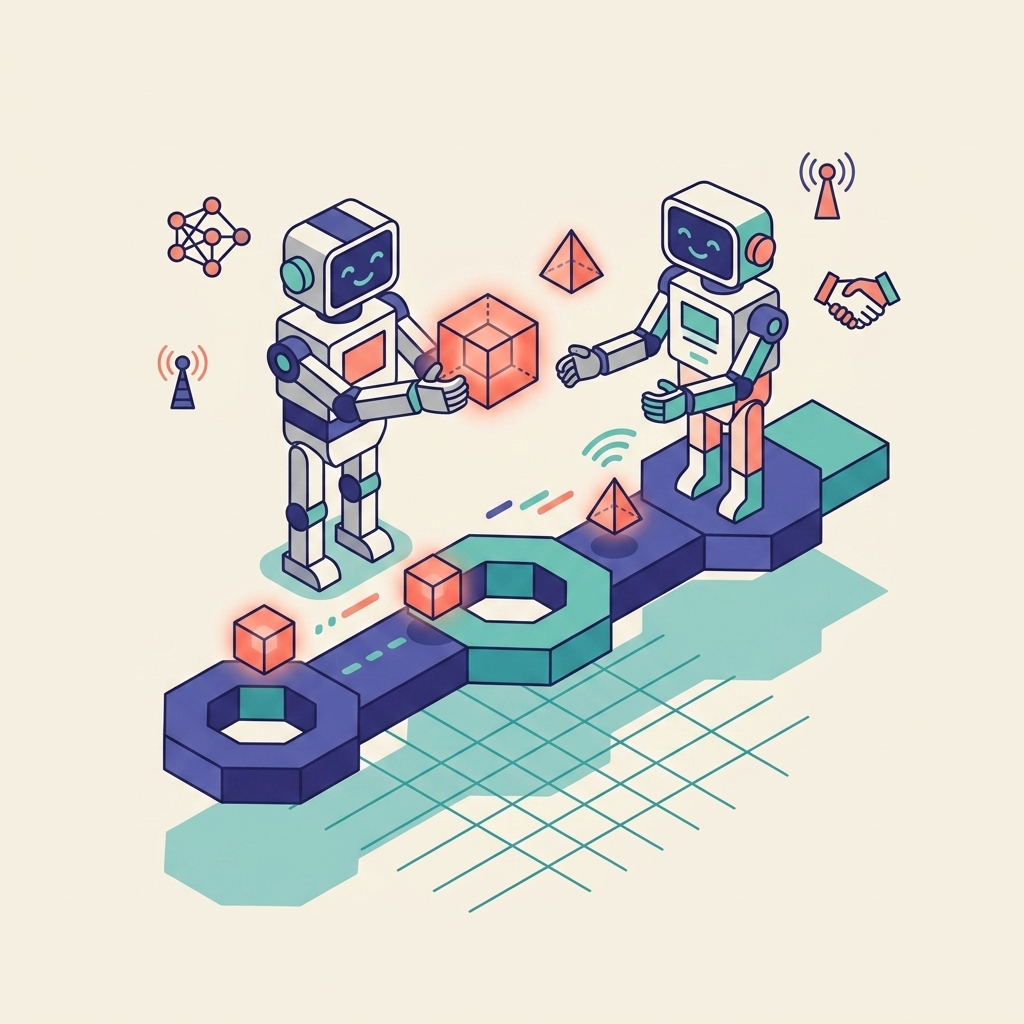
The true paradigm shift of 2026 is Agent-to-Agent (A2A) communication. We are rapidly approaching a world where your persistent local AI agent will interact directly with your client's AI agent, negotiating terms, scheduling meetings, and exchanging data without human intervention.
If you are an independent consultant or creative freelancer, understanding A2A is not optional. It is the new foundation of digital commerce.
What is Agent-to-Agent (A2A)?
A2A occurs when two autonomous systems communicate via APIs or natural language to achieve a goal.
Imagine you are onboarding a new client. Instead of spending three days emailing back and forth to find a meeting time, sign an NDA, and collect brand assets, your agent takes over. Your local agent pings their corporate agent. They compare calendars instantly, securely exchange the signed NDA cryptographic hashes, and transfer the brand assets directly into your local vector database.
The humans only get involved when a strategic decision is required. I call this being the "Human on the Balcony"—you oversee the system rather than executing the micro-tasks.
Why A2A Changes the Creative Economy
During my years producing assets for massive entities like Disney, the actual creative work was often dwarfed by the sheer volume of logistical friction: finding the right file, checking compliance, and navigating corporate vendor portals.
A2A obliterates this friction. But it also presents a massive risk to the unprepared.
1. The Rise of the Machine Consumer
In an A2A world, your marketing isn't just speaking to human project managers; it is being indexed and evaluated by their procurement agents. If your services are not structured in a way that an AI can easily parse, categorize, and verify (hello, semantic HTML and strict Schema markup), you will be invisible to machine buyers.
2. The Data Sovereignty Mandate
When your agent talks to a client's agent, data is being exchanged. If your agent lives in a walled-garden cloud environment (like OpenAI's servers), your client's proprietary data is passing through a third party. This is why I aggressively advocate for local, open-source AI models. When my local agent negotiates with a client, the data exchange is direct and cryptographically secure.
3. The Death of the CAPTCHA
The internet was built to verify humans. A2A requires an internet built to verify authorized agents. We will see the rapid death of traditional web interfaces (and CAPTCHAs) in B2B interactions, replaced by direct API-to-API and secure agent handshakes. This is exactly why my golden rule for software procurement is "No API, No Buy."
Preparing for the A2A Future
How do you prepare for a world where your AI does the talking?
First, you must build your local agent. You need a centralized, local system that holds your context, your calendar, and your operational parameters.
Second, standardize your data. Whether I am managing donor relations for my charity Become Inspired or pitching a fractional AI consulting retainer, my data is strictly formatted. Messy, siloed data cannot be effectively utilized by an agent.
Step off the dance floor and get onto the balcony. Your agent is ready to take the meeting.
FAQ
Q: What does Agent-to-Agent (A2A) mean?
A: A2A refers to the direct communication and negotiation between two autonomous AI systems to accomplish tasks—like scheduling or secure data transfer—without requiring human intervention.
Q: Why is local AI better for A2A communication?
A: Local AI guarantees data sovereignty. When your local agent communicates with a client's agent, sensitive information is processed securely on your hardware, not stored and analyzed on a third-party cloud server.
Q: How do I optimize my business for machine buyers?
A: Ensure your digital presence uses clear, structured data (like JSON-LD Schema) and that your services can be accessed or queried via open APIs. AI agents process structured data, not visual web design.