The end of the month is traditionally a nightmare for freelancers and agencies. You spend days pulling data from Google Analytics, CRM platforms, and ad networks, pasting it into a PowerPoint deck, and trying to write a compelling narrative about "growth."
When I worked in massive agency structures dealing with brands like Disney, we had entire analytics departments dedicated to this. As a solo AI Consultant, I automate the entire process.
Here is how you can use AI to build an automated reporting engine that keeps your clients happy and your retainers secure.
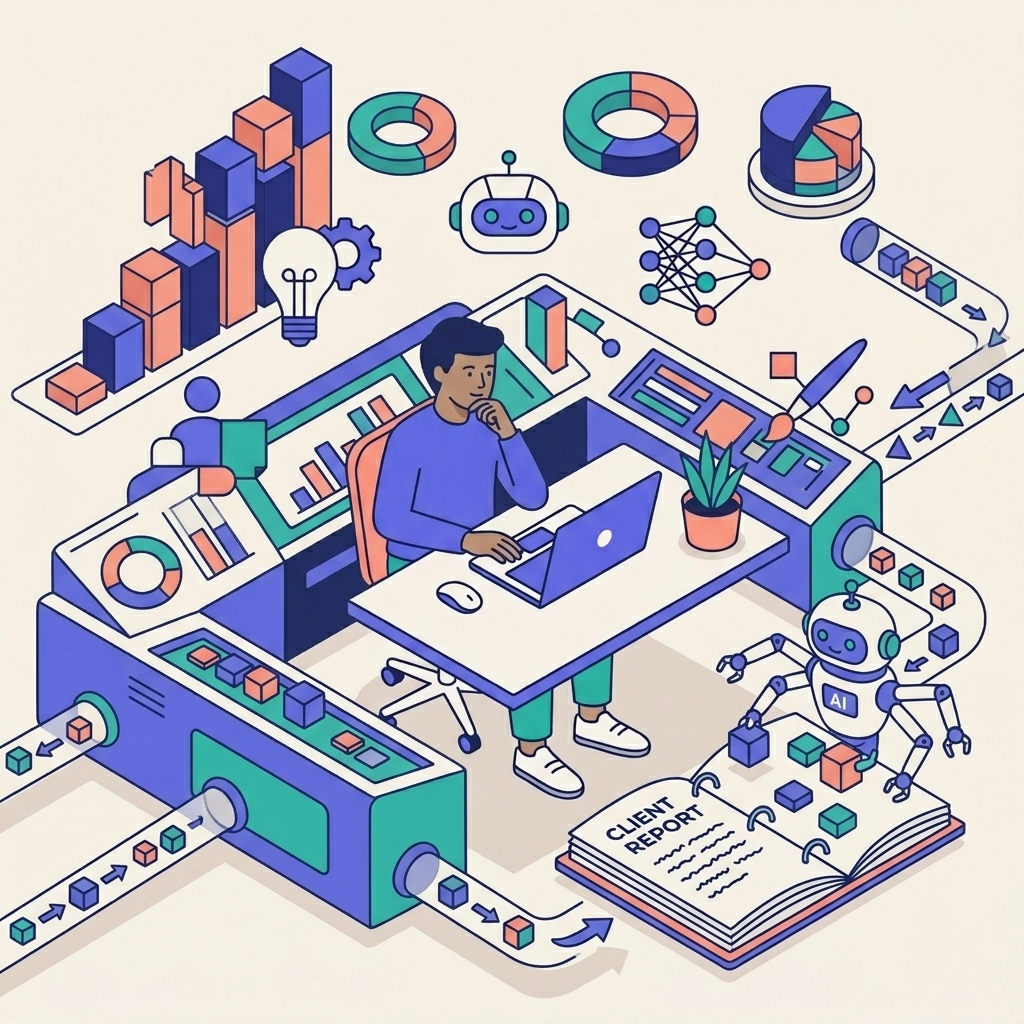
The Architecture of an AI Report
You cannot simply ask ChatGPT to "write a report." You need a structured pipeline that pulls hard data and applies intelligent synthesis.
1. Data Aggregation (The Plumber)
I use automation platforms (like Zapier or Make.com) to extract raw data on the 28th of every month. It pulls traffic stats, project completion metrics from Linear, and lead generation data from the CRM, compiling it into a single JSON or Markdown file.
2. The Analyst Agent (The Brain)
This raw data is automatically sent to an LLM (Claude 3.5 Sonnet is my preferred model for structured writing). The system prompt is highly specific:
"You are a Senior Strategic Consultant. Review the provided monthly performance data. Draft an executive summary highlighting the top 3 wins, identifying 1 bottleneck, and proposing 2 strategic recommendations for next month. Maintain a professional, confident tone."
3. The Formatter (The Presentation)
The LLM outputs the narrative. If the client requires visual dashboards, I use the Claude Artifacts feature to generate a React dashboard component, or push the data directly into a pre-formatted Google Data Studio template.
The "Human in the Loop" Check
Automation is powerful, but sending unreviewed AI content to a paying client is a massive risk.
My automation pipeline pauses right before the email is sent. It drops the drafted report into a Notion database. I spend exactly 10 minutes reviewing it. I might add a personal note about a conversation we had last week, or adjust the strategic recommendation based on intuition the AI lacks.
Scaling Operations
This workflow is exactly how I manage the impact reporting for my charity, Become Inspired. Donors want transparency and regular updates on where their money is going, but as a lean operation, I cannot spend 20 hours a week writing donor reports.
By automating the data aggregation and the first draft of the narrative, I can provide enterprise-level reporting to clients and stakeholders while remaining a one-person remote operation.
About the Author
Simon Bullows is an AI Consultant helping remote teams and freelancers stay on brief. With a background working on projects for Marvel and Disney, Simon brings enterprise-level creative strategy to the solo economy. He is also the founder of the charity Become Inspired.
Frequently Asked Questions
Can AI analyze numerical data accurately for reports? Yes, but you should use AI for the synthesis and narrative generation, while relying on explicit integrations (like Make.com pulling from Google Analytics) to fetch the hard numbers securely.
Will clients care if a report is AI-generated? Clients care about clarity, accuracy, and strategic insight. As long as the AI report is accurate and provides high-level human commentary on the next steps, the method of generation is a feature, not a bug.