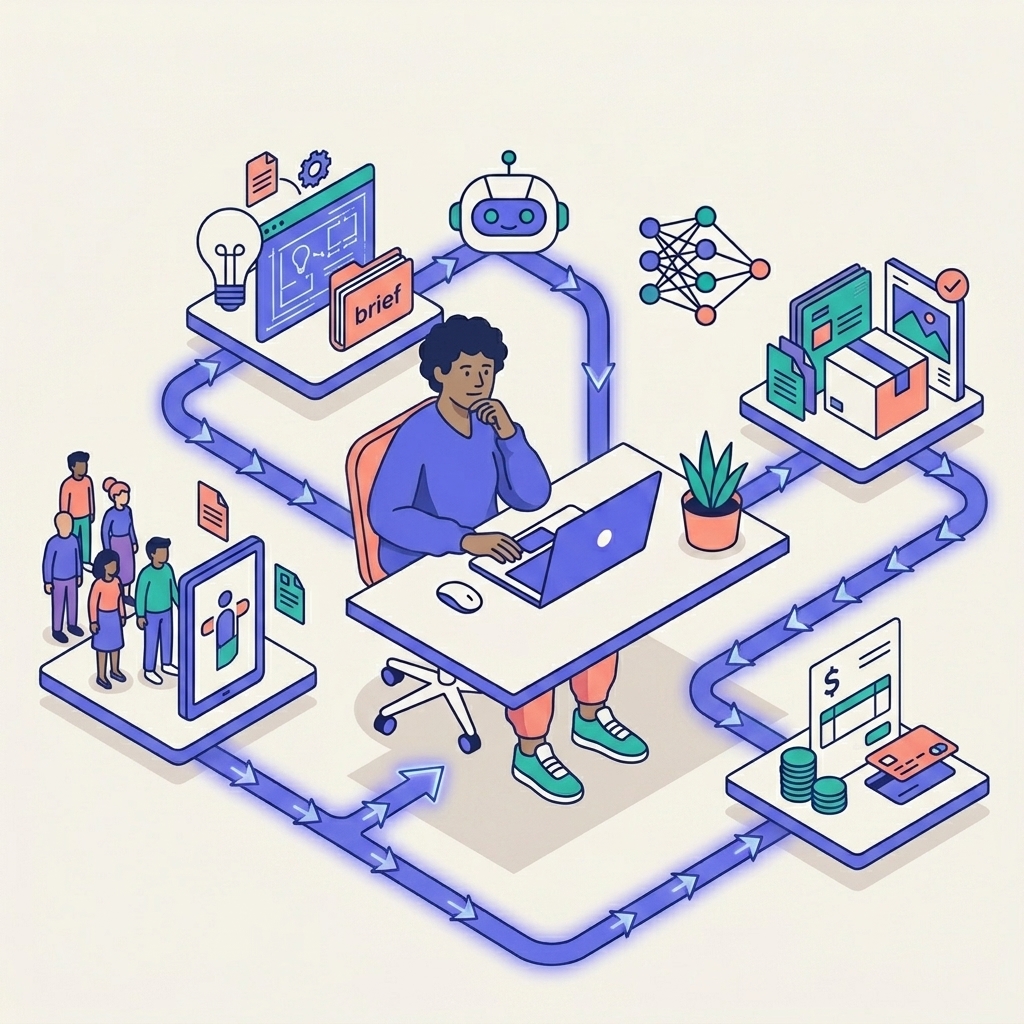
To build an agency-level workflow as a solo consultant, you must chain multiple specialized AI agents together. One agent researches, one drafts, one critiques, and one formats. This multi-agent approach replaces traditional prompt engineering.
As an AI consultant helping remote workers stay strictly on brief, the biggest shift I've seen in May 2026 is the death of the "megaprompt." We are no longer asking one AI model to do ten things poorly. We are using multi-agent frameworks to have different AI personas collaborate.
When I ran design teams for Marvel and Disney, the workflow was highly specialized: penciler, inker, colorist. I apply that exact same logic to my AI workflows today.
How to Set Up a Multi-Agent Workflow
1. The Researcher Agent (Perplexity)
The workflow starts with deep data gathering. I deploy an agent specifically instructed to search the live web, pull current statistics, and output a structured data sheet. It does no creative writing.
2. The Strategist Agent (Claude 3.5)
The data sheet is passed to Claude. I instruct Claude to act as a cynical strategist. Its job is to review the data against the client's creative brief and highlight what is relevant and what is noise.
3. The Creator Agent (GPT-4o)
Only after the strategy is locked do I deploy the creator agent to generate the actual copy, code, or design prompts. Because it is fed a refined strategy document rather than a blank slate, the output is infinitely sharper.
4. The Editor Agent
Finally, a separate instance of Claude acts as the Editor. It runs a checklist against the draft: Does it sound human? Does it meet the brand tone? Are the facts correct?
The Impact on Remote Work
For my charity Become Inspired, this means I can execute massive fundraising campaigns essentially single-handedly. By orchestrating agents rather than executing tasks, remote consultants can offer the throughput of a 5-person agency without the overhead.
FAQ
Q: What is a multi-agent AI framework?
A: It is a system where multiple specialized AI models interact with each other in a sequence, passing data back and forth to complete a complex task.
Q: Do I need to know how to code to build agent workflows?
A: Not anymore. Tools like Zapier Central, Make.com, and custom GPTs allow you to chain agents together using visual interfaces and natural language.