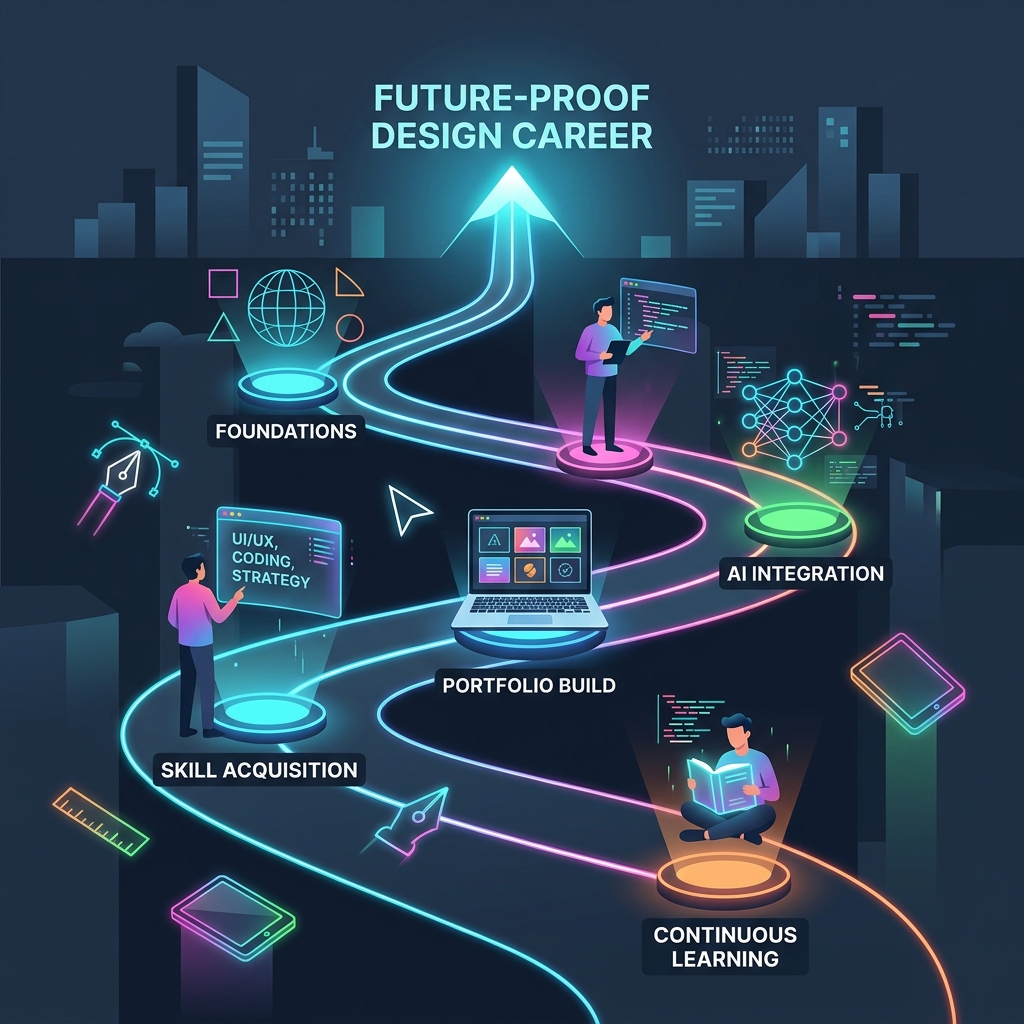
The question I am asked most often by designers — at workshops, from students, in DMs — is some version of: "Is AI going to take my job?"
After 20+ years working as a commercial designer, including work for Marvel and Disney properties, and now spending significant time consulting organisations on AI adoption, I can give you a more useful answer than the usual optimistic hand-waving or doom-mongering.
The honest answer: AI is going to take some design jobs, it has already changed many design roles, and the designers who understand exactly what is happening will build more interesting and more sustainable careers than their predecessors could.
This is the guide I wish existed when I started navigating this shift.
What AI Has Actually Changed in Design (From Someone Doing It)
Let me start with what I have personally observed and experienced, not what the thinkpieces say.
What AI has genuinely disrupted:
- Stock illustration and generic image creation — the market for buying and selling generic stock images has effectively collapsed. If you were relying on stock illustration as a revenue stream, that has changed.
- Simple asset production — resizing, background removal, basic retouching, creating multiple format variations — tasks that previously consumed hours are now minutes.
- First-draft ideation — the time from "blank canvas" to "10 visual directions to choose from" has compressed dramatically.
- Copywriting for creative assets — AI now writes competent first-draft ad copy, packaging text, and marketing materials at a quality that removes most of the iteration cycles.
What AI has NOT disrupted (and likely cannot):
- Strategic creative direction — deciding what a brand should look like, feel like, say, and represent. This requires cultural understanding, commercial judgement, and genuine experience.
- Client relationship management — understanding what a client actually needs (which is usually different from what they say they need) requires human reading of human situations.
- Taste and curation — AI generates options. Someone with developed aesthetic judgement has to select the right one. This skill has become more, not less, valuable.
- Licensed and constrained commercial work — working to exact brand specifications, approval chains, and style guides requires technical precision and process understanding that AI cannot yet navigate independently.
- Original creative direction with genuine cultural relevance — the things that make a campaign resonate are specific, culturally situated, and often rooted in genuine human experience that AI cannot have.
The Three Types of Design Career in 2026
Having watched the industry shift over the last few years, I see design careers sorting into roughly three categories:
Type 1: AI-Integrated Generalists
These designers use AI tools to expand their output capacity and service range. They are typically solo or small-team operators who previously could only offer one or two services and now offer a broader integrated creative service because AI handles the time-consuming production work.
This is broadly where I operate — using AI to handle first-draft ideation, variation production, and documentation work, freeing my time for strategy, direction, and client work.
Trajectory: Strong. The ability to deliver more value at competitive price points is a durable advantage.
Type 2: Deep Specialists
These designers have chosen one area and gone extremely deep — custom lettering, high-end print production, motion design for specific industry sectors, etc. Their value is not volume or speed; it is irreplaceable craft and niche expertise.
AI tools are useful to these designers but do not define their competitive position.
Trajectory: Strong, but requires genuine specialisation rather than self-described specialisation. Markets are good at detecting the difference.
Type 3: Production Generalists Without AI Integration
These designers provide a broad range of standard design services — social media graphics, brochures, websites, etc. — at mid-market rates, using primarily manual tools and traditional workflows, without meaningful AI integration.
This is the most precarious position. The market for this service has not disappeared, but the price pressure is increasing as AI tools enable clients and junior practitioners to produce acceptable-quality work more cheaply.
Trajectory: Difficult. Adaptation is required, and the adaptation needs to happen sooner rather than later.
The Practical Path: Building a Career That Lasts
Based on my own career and what I have observed advising organisations on creative AI adoption, here is the most practical path I can offer.
Step 1: Develop an AI Tool Practice, Not Just an AI Tool Knowledge
There is a difference between knowing about Midjourney and having a genuine working practice with it — including understanding its failure modes, the workflow around it, and how to integrate it with other tools and processes.
Build a genuine practice with at least two or three AI tools that are directly relevant to your work. This means using them on real projects, understanding their limitations, and developing your own workflow. This takes months, not days.
My primary creative AI tools in 2026:
- Adobe Firefly — for commercial work where provenance matters
- Midjourney — for concept ideation and client visual references
- Claude — for strategy, creative brief development, and client documentation
- Runway ML — for any work involving motion or video
Step 2: Develop Your Taste and Curatorial Judgement
This is the skill that AI cannot generate. AI produces options — volumes of options, at extraordinary speed. The question of which option is right, and why, and how to push it further in the right direction, requires developed aesthetic and strategic judgement.
Developing taste requires:
- Deep familiarity with design history and visual culture
- Sustained engagement with high-quality creative work across disciplines
- Feedback from practitioners with developed judgement — working under and alongside better designers
This is not something you can shortcut. It is also not something AI will replace.
Step 3: Build Your Professional Evidence Base
E-E-A-T — Experience, Expertise, Authoritativeness, Trustworthiness — is not just a Google framework. It is how clients and employers evaluate creative professionals.
Your professional evidence base includes:
- A portfolio of real commercial work with real outcomes
- Verifiable credits and project references
- Professional network relationships that can vouch for your work
- Public-facing demonstrations of your thinking (writing, speaking, teaching)
AI makes many things faster. It does not build your reputation. That still requires time and genuine work.
Step 4: Understand the Business Context of Design
The designers who have had the most durable careers I have observed are those who understand the commercial context their work exists in. They know why the client wants what they are asking for, what business objective the design is serving, and how to frame their recommendations in terms of business outcomes.
This understanding makes you harder to replace by a cheaper or faster alternative — because the judgement you bring to the work is not just aesthetic, it is commercial.
On AI Consulting as an Adjacent Career
A growing number of experienced designers are moving into AI consulting — helping organisations understand how to adopt AI tools in their creative and marketing functions. This is genuinely in demand, particularly from mid-sized companies that have neither the budget for expensive consultancies nor the internal expertise to navigate the AI transition confidently.
If this interests you, the most credible path is deep personal practice with AI tools combined with genuine understanding of organisational change — not just the technology, but how organisations actually adopt and resist new practices.
I have been doing this consulting work for several years now, and the demand has increased significantly. If you are interested in exploring this direction, I write about it regularly and am available for consulting conversations via the contact page.
The Uncomfortable Truth
AI has made design work faster and in some respects easier. It has also raised the bar for what "good" looks like by giving everyone access to acceptable quality quickly.
This means the difference between a mediocre designer and an excellent one is now more visible, not less — because the baseline has risen. The designers who thrive in this environment will be those with genuine craft, developed taste, real experience, and the strategic intelligence to add value that tools cannot.
That has always been the foundation of sustainable creative careers. AI has made it more important, not less.
FAQ
Q: Should I learn to code as a designer in 2026? A: Basic understanding of how digital products are built is genuinely useful. Deep coding skill is not required for most design careers. AI tools like GitHub Copilot and Cursor mean that a designer with basic understanding of code can now prototype interactive ideas themselves — which is valuable. But traditional coding fluency is not the priority for most designers.
Q: Which AI design tools should I learn first? A: Firefly if you do commercial work (brand-safe, commercially indemnified). Midjourney if you want the best current image generation quality for concept work. Claude if you want to improve your strategy and writing. These three cover most creative professional use cases.
Q: Is a design degree still worth doing in 2026? A: A good design education teaches you to see, to think, and to develop taste — skills that remain highly valuable. The ROI depends heavily on which programme and which institution. Portfolio-based hiring means a strong portfolio from self-directed learning can be equivalent to a degree. But the structured critique and peer environment of a good design programme is difficult to replicate independently.
Q: How do I position myself as a designer who uses AI without losing clients who are sceptical? A: Be transparent and frame around outcomes. Most clients care about the quality and value of the result, not the tools used to produce it — in the same way they do not ask which version of Photoshop you used. If clients are specifically concerned about AI image provenance for brand or legal reasons, use Adobe Firefly, which has commercial content indemnity.
Q: What is the best way to stay current with AI developments without spending all day reading about them? A: Follow three or four practitioners you trust who are actually using the tools, not just writing about them. Spend one hour per week deliberately experimenting with something new. The practitioners worth following will surface what matters. Most of the output from AI-focused media is noise.