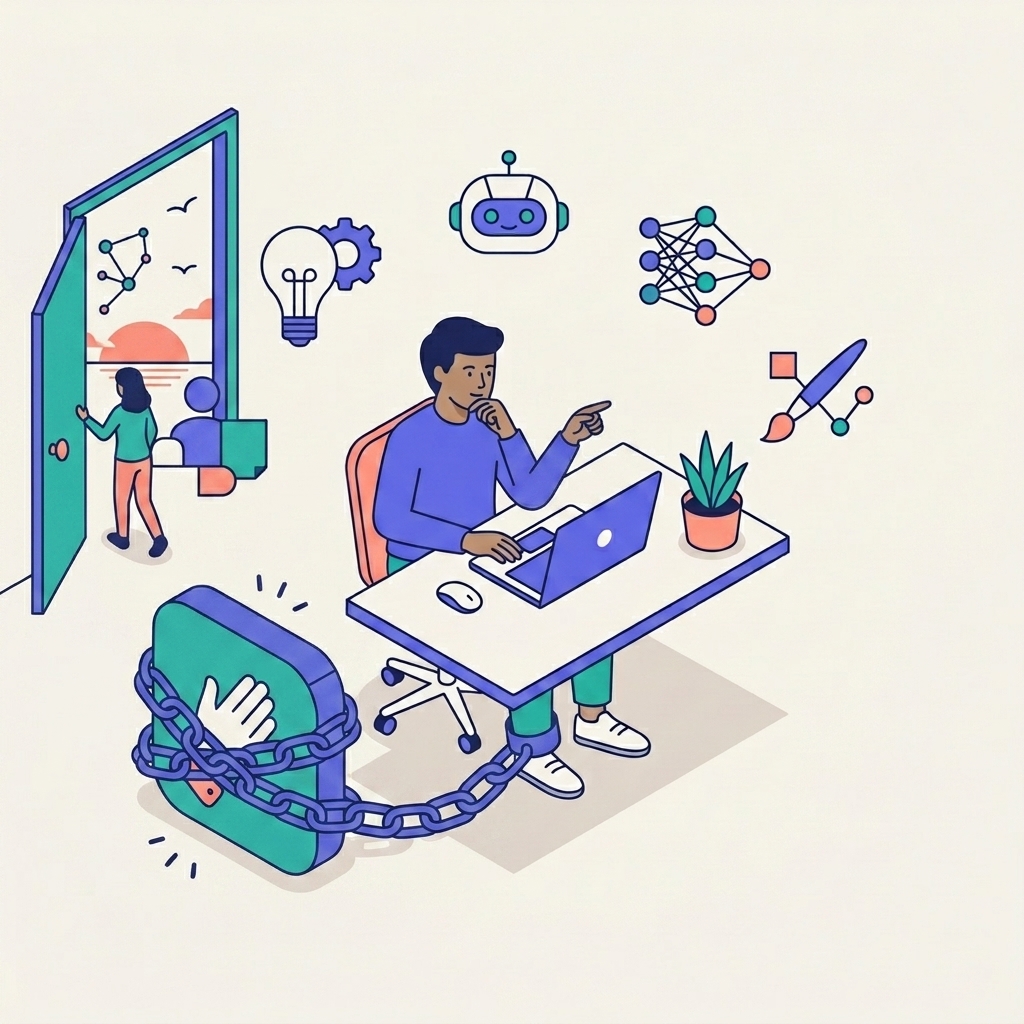
Every time a platform makes something easier, it also makes you more dependent. The one-click signup. The seamless integration. The "we'll handle everything" promise. Each convenience is a thread in a web of dependency that becomes visible only when you try to leave.
The Convenience Trap
The pattern is universal:
- "Sign in with Google" saves 30 seconds. It also gives Google a map of every service you use.
- "Store your files in the cloud" saves the hassle of backup management. It also means your files exist on servers you don't control.
- "Use our AI for free" saves you money. It also means your data trains their models.
- "Let us manage your email list" saves technical complexity. It also means your audience relationship is mediated by a third party.
Each individual convenience is rational. In aggregate, they create a digital life where you control very little.
The Freedom Alternative
Freedom requires friction. Not crippling friction, but enough deliberate inconvenience to maintain control:
Accept Slightly More Setup Time
Self-hosting n8n takes longer to set up than signing up for Zapier. But once running, you own the infrastructure, the data, and the workflows. The initial friction is an investment in long-term autonomy.
Accept Slightly Less Polish
Open-source tools are sometimes less polished than their commercial equivalents. The trade-off is that your data stays yours, the tool can't change its terms overnight, and you're not subject to another company's business decisions.
Accept Slightly More Responsibility
When you use a managed service, they handle security, backups, and updates. When you self-host, you handle these. This responsibility is the price of control—and it's a price worth paying for critical infrastructure.
Where Convenience is Fine
Not every decision needs to prioritise freedom. The cost-benefit calculus depends on what's at stake:
- Low-stakes, non-sensitive tasks: Use the convenient option. Google search, free AI for brainstorming, social media for casual sharing.
- High-stakes, sensitive tasks: Use the freedom option. Local AI for client analysis, self-hosted tools for business automation, your own domain for content publishing.
The mistake is defaulting to convenience for everything. The wisdom is choosing consciously.
The Long-Term View
Digital freedom compounds, just like digital dependency. Every tool you choose that respects your autonomy is a brick in a foundation you control. Every convenient shortcut that surrenders control is a brick in someone else's wall.
In five years, the person who invested in freedom has a fully portable, sovereign digital infrastructure. The person who optimised for convenience has a comfortable cage.
Choose your architecture deliberately.