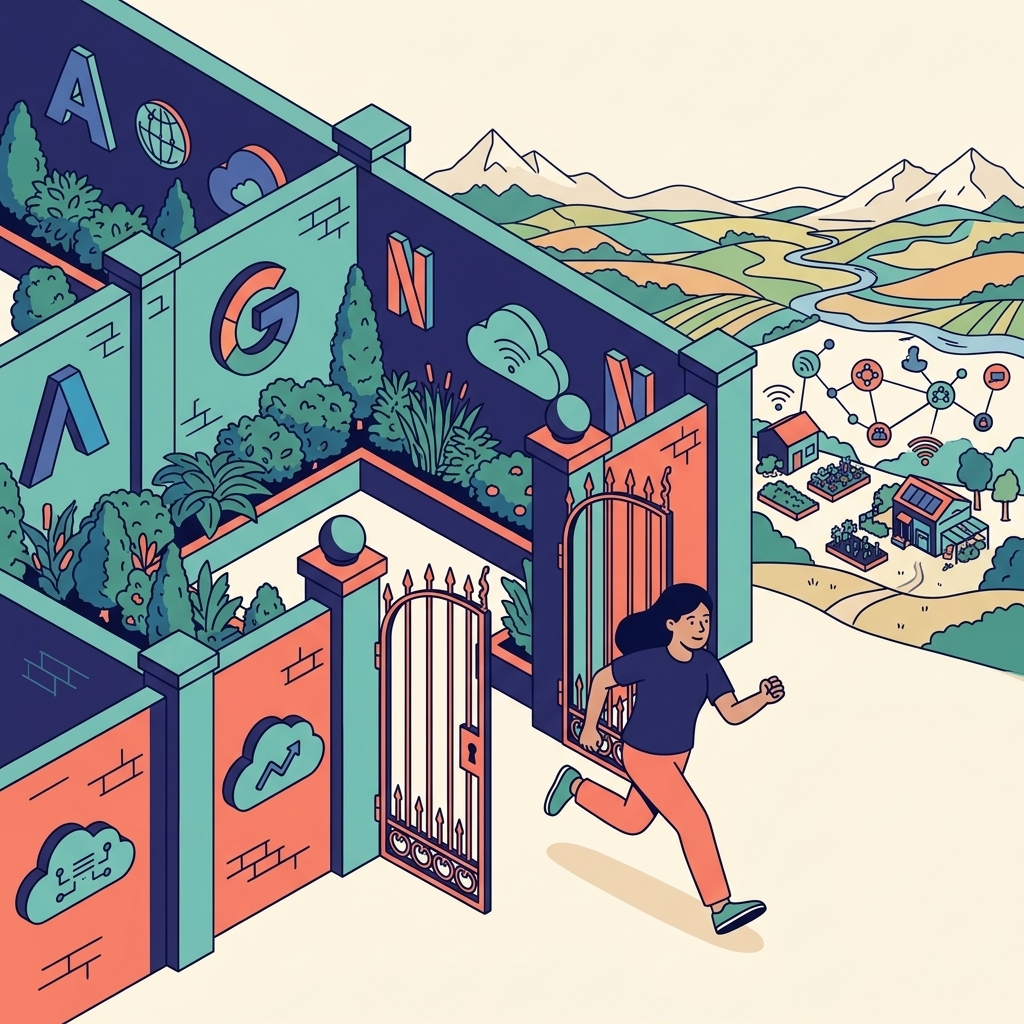
A walled garden is a technology ecosystem designed to keep you inside. Your data is stored in proprietary formats. Your workflows depend on platform-specific features. Your audience is owned by the platform, not by you. And leaving means losing everything you've built.
This is not accidental. It's the business model.
How Walled Gardens Work
The pattern is consistent across platforms:
- Attract: Offer excellent free features to get you in
- Embed: Make your workflows depend on platform-specific features
- Lock: Store your data in formats that don't export cleanly
- Monetise: Gradually increase prices, knowing switching costs are now prohibitive
- Trap: When you want to leave, you discover your data, audience, and workflows can't come with you
The Walled Gardens You Might Be In
- Social media platforms: Your audience lives on their servers. If they change the algorithm or ban your account, your audience vanishes.
- SaaS tools without data export: If your project management tool doesn't let you export your data in standard formats, you don't own your data.
- Email marketing platforms with proprietary templates: If your email designs only work within one platform, migration means starting from scratch.
- Cloud storage with format lock-in: Proprietary document formats that don't render correctly outside the ecosystem.
The Escape Strategy
1. Own Your Audience
Build your email list on a platform that allows full subscriber export (CSV at minimum, API-accessible ideally). Your blog lives on your domain. Your content exists as files you control.
2. Use Standard Formats
- Documents: Markdown (plain text, universally portable)
- Data: CSV, JSON (standard, open formats)
- Images: PNG, SVG, JPEG (standard formats, not platform-proprietary)
- Code: Git repositories on platforms that allow migration
3. Apply the "No API, No Buy" Rule
Every tool in your stack must expose an API. This ensures you can always extract your data programmatically, even if the platform makes manual export difficult.
4. Keep Local Backups
Your critical data should exist in at least two places:
- On the platform (for convenience and collaboration)
- On your local machine or your own server (for sovereignty and disaster recovery)
Obsidian is the embodiment of this principle: your notes are plain markdown files on your hard drive. No server, no subscription, no lock-in. If Obsidian disappears tomorrow, your data is untouched.
5. Plan Your Migration Path
For every tool you use, know the answer to: "If this platform shut down tomorrow, how would I migrate?" If you can't answer that question, you're in a walled garden.
The Philosophy
Digital autonomy means owning the infrastructure of your professional life. Your data. Your audience. Your workflows. Your creative output. These are not assets the platform is generously hosting for you—they are your property, and any tool that makes them difficult to extract is working against your interests.
Build on platforms that respect your right to leave. That's the ultimate test of a healthy technology relationship.