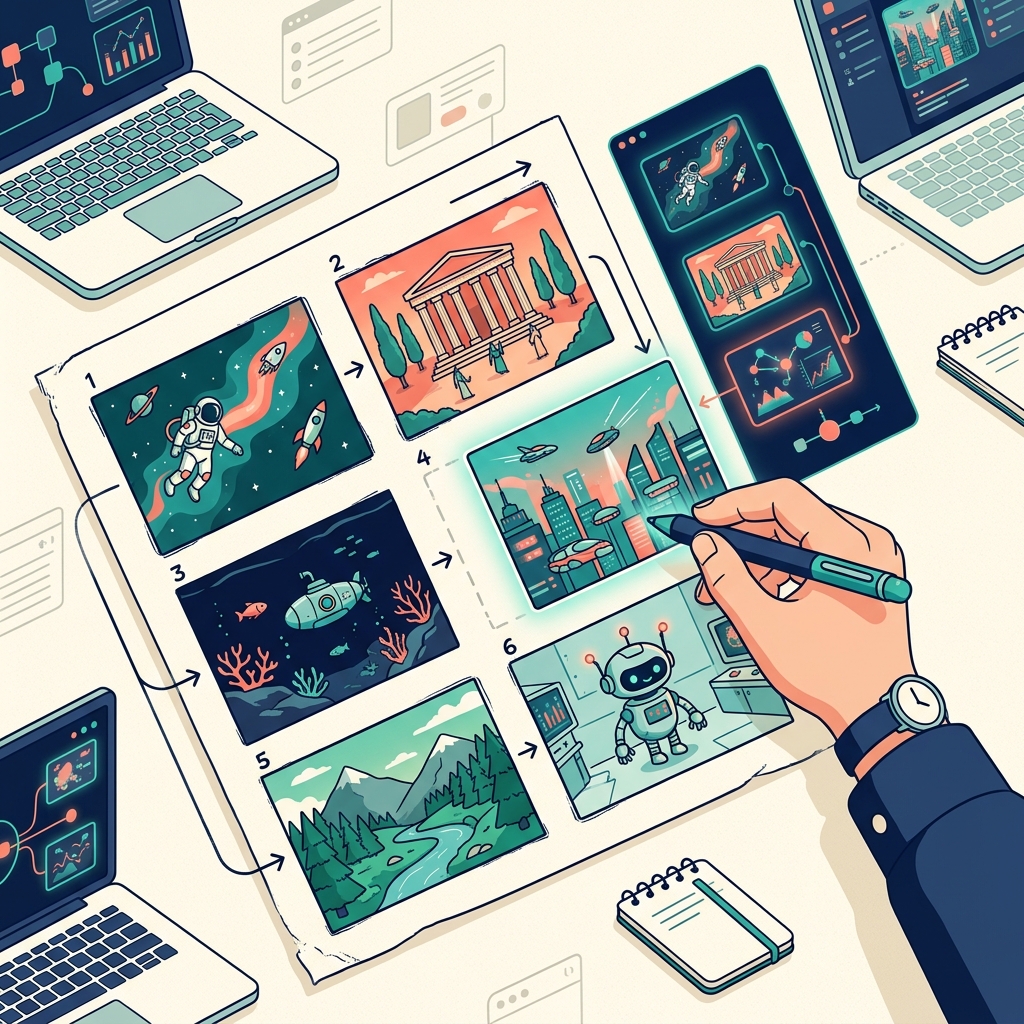
During my years working in creative direction for brands like Marvel and Disney, storyboarding was a massive bottleneck. You had a brilliant concept for a campaign, but you had to wait days for a sketch artist to visualize it before you could even pitch it to the client.
Today, as an AI Consultant advising remote creative teams, I teach a workflow that compresses that timeline from weeks to minutes.
With the release of Midjourney v7, the ability to maintain character consistency and specific cinematic framing has turned it into the ultimate storyboarding tool. Here is how to keep your visual campaigns "on brief."
The Problem with Generative Storyboards
In the early days of AI image generation, prompting "a hero walking away from an explosion" would yield a cool image. But if you prompted "the same hero looking back at the explosion," you'd get a completely different character with different clothes.
For agency-level storyboarding, consistency is everything. You cannot pitch a campaign if the protagonist changes faces in every frame.
The Midjourney v7 Workflow
1. Establish the "Bible"
Before generating a single storyboard frame, you must establish the visual rules. I use the --cref (character reference) and --sref (style reference) parameters extensively.
I generate a "Master Character" sheet and a "Master Style" sheet (dictating the color grading, film stock, and lighting). Every subsequent prompt references these exact parameters.
2. Prompting like a Director
When writing prompts for storyboards, you must stop thinking like a digital artist and start thinking like a Director of Photography. Instead of: "A woman drinking coffee." You must write: "Medium wide shot, low angle, 35mm lens. A woman in a red coat drinking coffee. Cinematic lighting, shallow depth of field, neon cyberpunk aesthetic --ar 16:9 --cref [URL] --sref [URL]"
3. Sequential Generation
I map out the 6-8 frames needed for the campaign pitch. Because Midjourney v7 understands spatial relationships and camera jargon, I can walk the AI through the sequence:
- Frame 1: Establishing wide shot.
- Frame 2: Over-the-shoulder tracking shot.
- Frame 3: Extreme close-up on the subject's eyes.
The ROI for Remote Consultants
When you walk into a virtual client pitch (or manage a campaign for a lean operation like my charity, Become Inspired) and present a fully rendered, cinematic storyboard instead of stick figures or disjointed mood boards, you instantly elevate your perceived value.
You are no longer just selling an idea; you are selling a vision they can actually see. AI doesn't replace the creative director's vision; it just gives them a Hollywood-level production studio on their laptop.
About the Author
Simon Bullows is an AI Consultant helping remote teams and freelancers stay on brief. With a background working on projects for Marvel and Disney, Simon brings enterprise-level creative strategy to the solo economy. He is also the founder of the charity Become Inspired.
Frequently Asked Questions
How does Midjourney v7 improve storyboarding over previous versions? Version 7 introduced unparalleled character consistency and strict adherence to specific camera angles and lighting setups, allowing you to create a cohesive narrative sequence rather than random, disjointed images.
Can I use AI storyboards in final client pitches? Absolutely. High-fidelity AI storyboards convey mood, lighting, and composition far better than traditional pencil sketches, helping clients visualize the final product immediately.