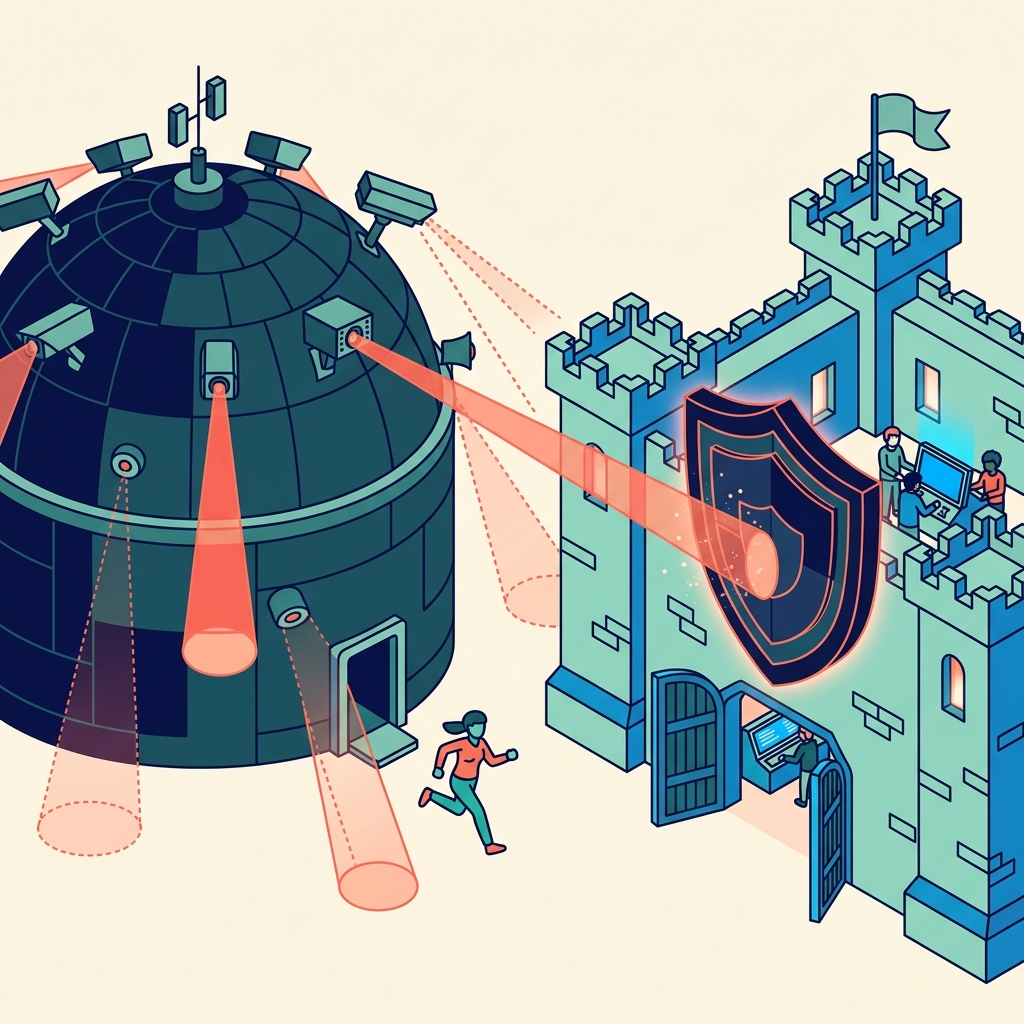
Every time you use a closed-source AI service, you're feeding your data into a system you cannot inspect, cannot audit, and cannot control. You trust the provider's privacy policy—a document that can change without notice and that you almost certainly haven't read.
Open-source AI is not just a technical preference. It's a structural safeguard against the concentration of surveillance power.
The Surveillance Problem
Closed-source AI services collect, store, and potentially analyse every interaction you have with them. This creates a detailed profile of your thinking, your business operations, your creative process, and your decision-making patterns. This data has value—to advertisers, to governments, and to the companies themselves for model training.
The fundamental asymmetry: they know everything about you. You know nothing about their systems.
What Open Source Changes
When AI models are open-source:
- The code is inspectable: Anyone can verify what the model does and doesn't do with your data
- The model runs locally: Your data never leaves your machine. No server logs, no training data collection, no third-party access
- The community audits: Thousands of researchers and developers examine open-source models for hidden behaviours, biases, and vulnerabilities
- The power is distributed: No single company controls access to the technology
The Current Open-Source Landscape
Open-source AI has reached remarkable capability levels:
- Meta's Llama models are available in various sizes for local deployment
- Mistral provides high-performance open models with permissive licensing
- Google's Gemma offers smaller, efficient models designed for local use
- Ollama makes running these models locally as simple as a single command
The gap between open-source and proprietary models is narrowing. For many professional tasks—drafting, analysis, brainstorming, code generation—open-source models running locally are more than adequate.
The Honest Trade-Off
Open-source AI is not universally superior:
- Frontier capabilities (the very latest, most capable models) are typically available as closed-source services first
- Convenience is lower: local setup requires more technical knowledge than signing into a web interface
- Compute requirements for the largest open models exceed what consumer hardware can handle
- Support is community-driven rather than commercially backed
The pragmatic approach: use open-source/local AI for sensitive operations and closed-source services (with paid tiers and privacy guarantees) for non-sensitive tasks that benefit from frontier capabilities.
The Broader Stakes
This isn't just about individual privacy. It's about the architecture of power in an AI-mediated world:
- If AI is controlled by a handful of corporations, those corporations become gatekeepers of intelligence itself
- If AI is open-source and distributed, intelligence becomes a public utility that anyone can access and deploy
- If governments can compel closed-source AI providers to share user data, every AI interaction becomes a surveillance vector
- If AI runs locally on your hardware, government access requires physical seizure of your device—a much higher legal bar
Supporting open-source AI is an investment in a future where intelligence tools are distributed rather than centralised. That distribution is the structural safeguard against surveillance overreach.
What You Can Do
- Run local models for your sensitive work (Ollama + any open model)
- Support open-source AI projects (use them, contribute feedback, fund development)
- Advocate for open-source in your professional network and content
- Stay informed about open-source developments and contribute to the community conversation