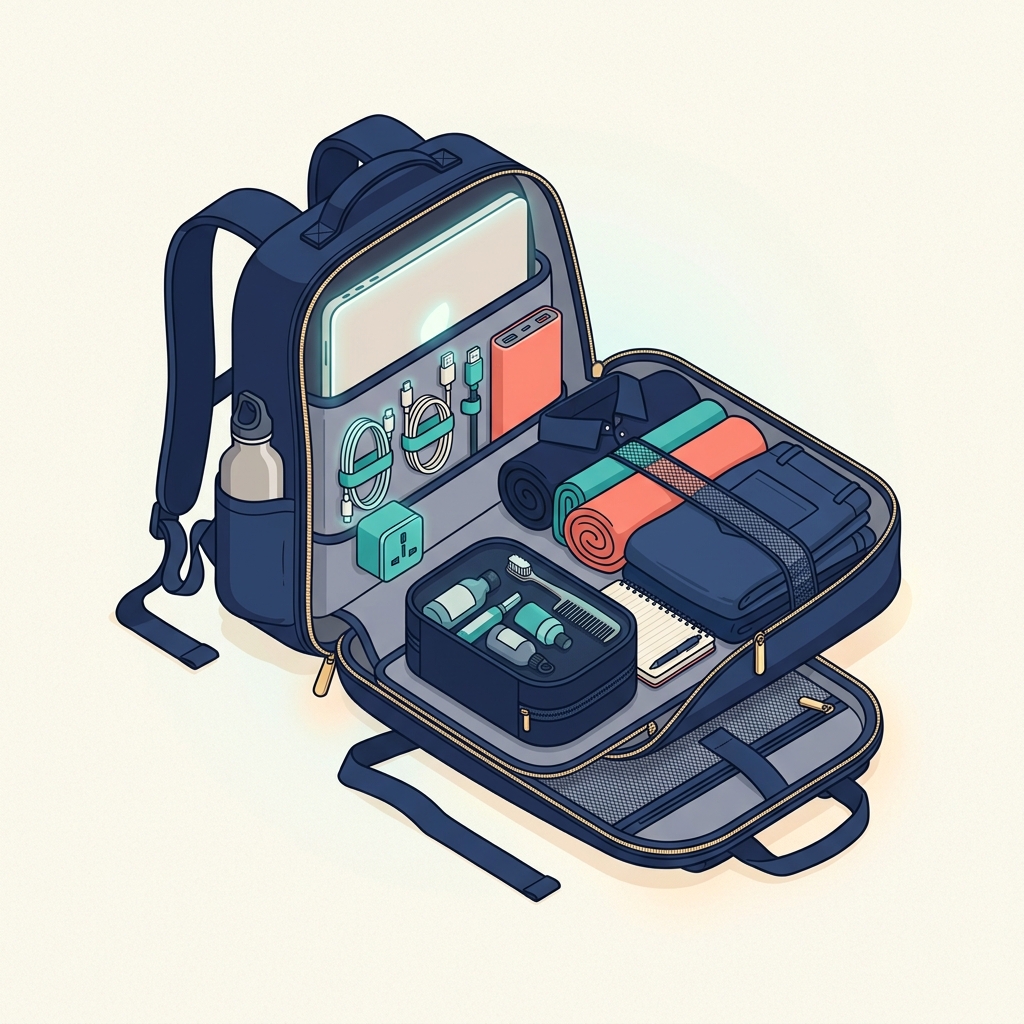
The best packing list is the shortest one. Every item you carry is a decision to manage, a thing to lose, and weight on your back. After multiple relocations, the principle is simple: pack for the first week, buy what you need locally, donate what you don't before you leave.
The Tech Layer (Non-Negotiable)
- Laptop (your entire office—see Post 56 for specs)
- Noise-cancelling headphones (work anywhere without distraction)
- USB-C charger (one that handles both laptop and phone)
- Universal travel adapter (for cross-border moves)
- Phone (backup internet, communication, navigation)
- Minimal cables (USB-C to USB-C, one spare)
Total tech weight: approximately 2-3kg depending on laptop.
The Clothing Layer (Minimal, Versatile)
The principle: choose items that work across contexts (casual, semi-professional, active) and can be mixed interchangeably.
- 3-4 t-shirts/shirts (including one that's presentable for video calls)
- 1 pair of trousers/jeans
- 1 pair of shorts (warm climate) or 1 additional trousers (cool climate)
- 1 lightweight jacket or hoodie (layering handles temperature variation)
- Underwear and socks (4-5 sets—you'll do laundry weekly)
- Comfortable walking shoes (one pair that handles both urban walking and casual settings)
- Sandals or flip-flops (warm climates, accommodation use)
Total clothing: fits in a packing cube. If you need more than one packing cube for clothes, you've overpacked.
The Essentials Layer
- Toiletries (travel-sized; buy full-sized locally on arrival)
- Basic medications (paracetamol, antihistamines, any prescriptions)
- Passport and copies (digital copies in encrypted cloud storage)
- Debit/credit cards (two from different providers for redundancy)
- Small daypack (packable backpack for daily use when your main bag stays at accommodation)
What to Leave Behind
- Books (e-reader or phone replaces an entire library)
- Bulky toiletries (buy locally—shampoo is available everywhere)
- Specialised clothing (one outfit for every possible scenario adds weight without value)
- Excess cables and adapters (USB-C handles almost everything)
- Souvenirs (ship them home or take photos instead)
The Bag
A single 30-40 litre backpack is the ideal format. It functions as carry-on luggage for budget airlines, eliminates checked bag fees, and forces disciplined packing.
The specific bag matters less than the constraint it provides. The limitation of "it must fit in this bag" is what drives the ruthless editing that makes packing light actually work.
The Mindset
Packing light is not deprivation. It's the recognition that your ability to move freely is worth more than any individual item. The things you own end up owning you—and when those things are in a backpack you carry between cities, the ownership burden is literal.
Pack for mobility. Buy for comfort on arrival. Donate before you leave.