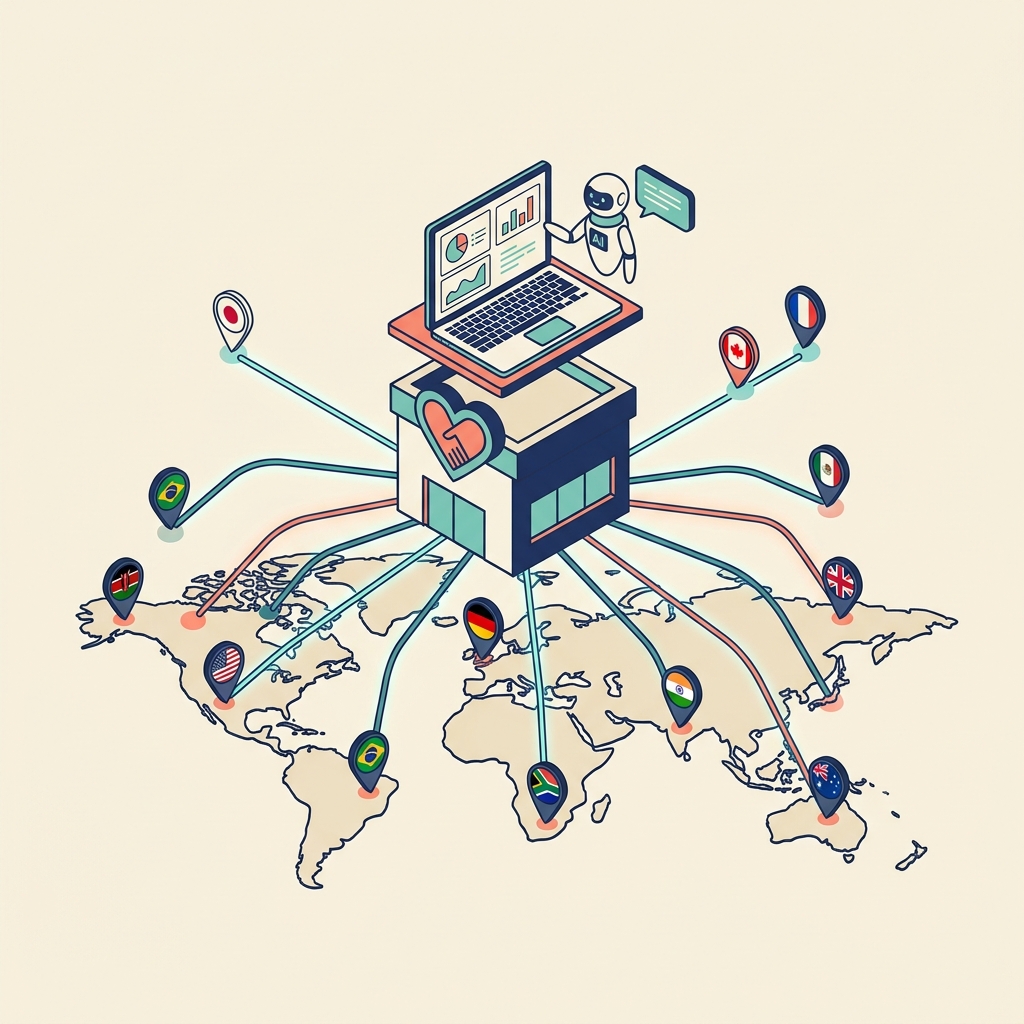
Become Inspired is a UK-registered charity I founded that uses creative workshops to build confidence and aspiration in young people. Since we began, we have run programmes that have reached over 100,000 children. In 2023 alone, I managed the charity's operations from 12 different countries.
This is not a feel-good story about passion overcoming obstacles. It is a practical account of the operational infrastructure — specifically the AI tool stack — that made it genuinely possible to run a registered charity to professional governance standards while being physically located almost anywhere on earth.
The Problem With Running a Charity Remotely
Charities in the UK operate under regulatory obligations that do not care where you are physically located. Trustee responsibilities, filing requirements with the Charity Commission, grant reporting, safeguarding documentation, board governance — all of these require consistent, high-quality attention regardless of whether you are in London or Chiang Mai.
The practical challenge is not just logistics. It is credibility. Funders, partners, and institutional stakeholders need to trust that the organisation is well-run. A charity that seems chaotic or poorly administered will not get grant funding, regardless of the quality of its work with young people.
This means the remote-operation infrastructure is not optional — it is existential. We either had systems that worked reliably across time zones, or we closed.
The AI Stack We Actually Use
Claude — For Governance and Grant Writing
Grant applications are the lifeblood of charitable funding in the UK. Each application requires specific framing, impact language, and evidence standards that vary by funder. Writing these well is time-consuming and requires a high level of writing quality.
Claude has transformed how I approach grant writing. My process:
- Paste in the funder's criteria and priority themes
- Give Claude a summary of our programme data and impact evidence
- Ask for a structural outline and draft
- Iterate on voice and specificity — the AI draft gives me the skeleton, I add the authentic detail and personal framing that funders respond to
I am clear that what funders fund is the authentic story and evidence. Claude helps me structure and express it efficiently. The difference between a bad grant application and a good one is often not the programme quality — it is whether the application clearly answers the funder's specific questions. Claude is excellent at that structural task.
I also use Claude for trustee meeting minutes drafts, policy documents, and Charity Commission correspondence. These are documents where precision and appropriate tone matter enormously.
Notion AI — For Team and Operations Management
Become Inspired has a small team of employed staff and a wider pool of workshop facilitators. Coordinating these people across different time zones, with different schedules, requires excellent asynchronous documentation.
We run Notion as our central operational system. Notion AI helps with:
- Summarising long threads in the team database so I can get context quickly when I reconnect after a travel gap
- Drafting facilitator briefing documents from a bullet-point outline
- Generating agenda items for board meetings based on recent activity logs
The key insight: remote team coordination is primarily a documentation and communication problem. AI tools that improve the quality and speed of documentation directly improve the quality of remote collaboration.
Otter.ai — For Board Meetings and Trustee Calls
Board meetings happen over video call. Having an accurate transcript is essential for governance purposes — minutes need to be accurate records, and decisions need to be documented.
Otter.ai automatically transcribes and summarises our trustee meetings. I use the transcript as the source document for formal minutes. This has reduced the time required to produce properly formatted minutes from two or three hours of careful note reconstruction to about 30 minutes of editing an AI summary.
Google Workspace + Gemini — For Safeguarding and Compliance Documentation
Safeguarding documentation in a children's charity cannot be approximated or managed informally. We use Google Workspace for all official documentation, with Gemini integrated for drafting and checking policy documents.
Gemini is particularly useful for checking that our safeguarding and HR policies are using current, appropriate language and covering the required areas. I use it to audit existing documents for gaps before renewal — not to replace legal review, but as a first-pass identification of areas requiring attention.
Canva AI — For Programme Materials
Creative workshop materials need to look professional. Funders and school partners judge the quality of materials as a proxy for the quality of the programme. With a small staff team, we cannot employ a dedicated designer for every piece of programme content.
Canva AI, with its Magic Studio feature set, allows our team to produce professional-quality workshop materials, impact reports, and promotional content without design training. The outputs are not at commercial design standard — but they are substantially better than what a non-designer would produce manually, and they are consistent with our brand.
What We Do Not Use AI For
It is worth being explicit about the boundaries.
Young person-facing creative content: The actual workshops are facilitated by humans. The creative prompts, the facilitation approach, the mentoring relationships — these are not mediated or replaced by AI tools. The value of Become Inspired to young people is the human creative connection.
Official Charity Commission submissions: These require careful human authorship and trustee sign-off. AI can help structure and draft, but the submission itself requires genuine trustee consideration and accountability.
Fundraising relationships: Relationships with major funders are built on trust and personal connection. I have never used AI to draft direct communications with senior programme officers — those messages need to be genuinely mine.
The Honest Assessment
Running a charity of this kind remotely, and at a reasonable governance standard, has been made genuinely possible by AI tools in a way it was not five years ago. The administrative burden reduction is substantial — I estimate I spend 40% less time on operational administration than I did pre-AI.
But the AI tools are a multiplier, not a replacement. They amplify the capacity of a committed, experienced team. They do not substitute for the professional judgement, safeguarding expertise, and genuine passion for the mission that make Become Inspired what it is.
If you are running or considering starting a charity, and you are concerned about administrative overhead, the tools above are worth evaluating seriously. The entry cost for a functional AI operational stack is now well within reach of even very small charitable organisations.
FAQ
Q: How do you maintain trustee governance when you are based overseas? A: Video call board meetings scheduled in advance, comprehensive Notion-based documentation systems, and clear delegated authority frameworks mean geography is largely irrelevant. The Charity Commission requires regular trustee meetings and proper minutes — technology enables this without physical co-location.
Q: What AI tools are safe to use for handling young people's data in a charity context? A: Your GDPR obligations as a charity apply to all data processing tools, including AI. We use Google Workspace (with appropriate data processing agreements) for any personal data. We do not put personal data relating to young people or programme participants into general AI tools like Claude or ChatGPT.
Q: How can charities access AI tools on limited budgets? A: Most major AI tools have non-profit or charity pricing available on request. Google Workspace for Nonprofits is free. Canva Pro is free for registered charities. Microsoft 365 for Nonprofits is heavily subsidised. Notion has a non-profit discount. The barrier is lower than most charity teams realise.
Q: Is Become Inspired accepting new workshop partnerships? A: Yes — we work with schools, youth organisations, and community groups across the UK. You can find information about our programmes and contact details at becomeinspired.co.uk.
Q: What has been the most operationally challenging aspect of running a remote charity? A: Safeguarding oversight. When you are physically absent, you need absolute confidence in your systems and your team's understanding of their responsibilities. We have invested significantly in training, documentation, and clear escalation processes. AI tools help document and maintain these systems, but the human judgement and accountability cannot be delegated to technology.