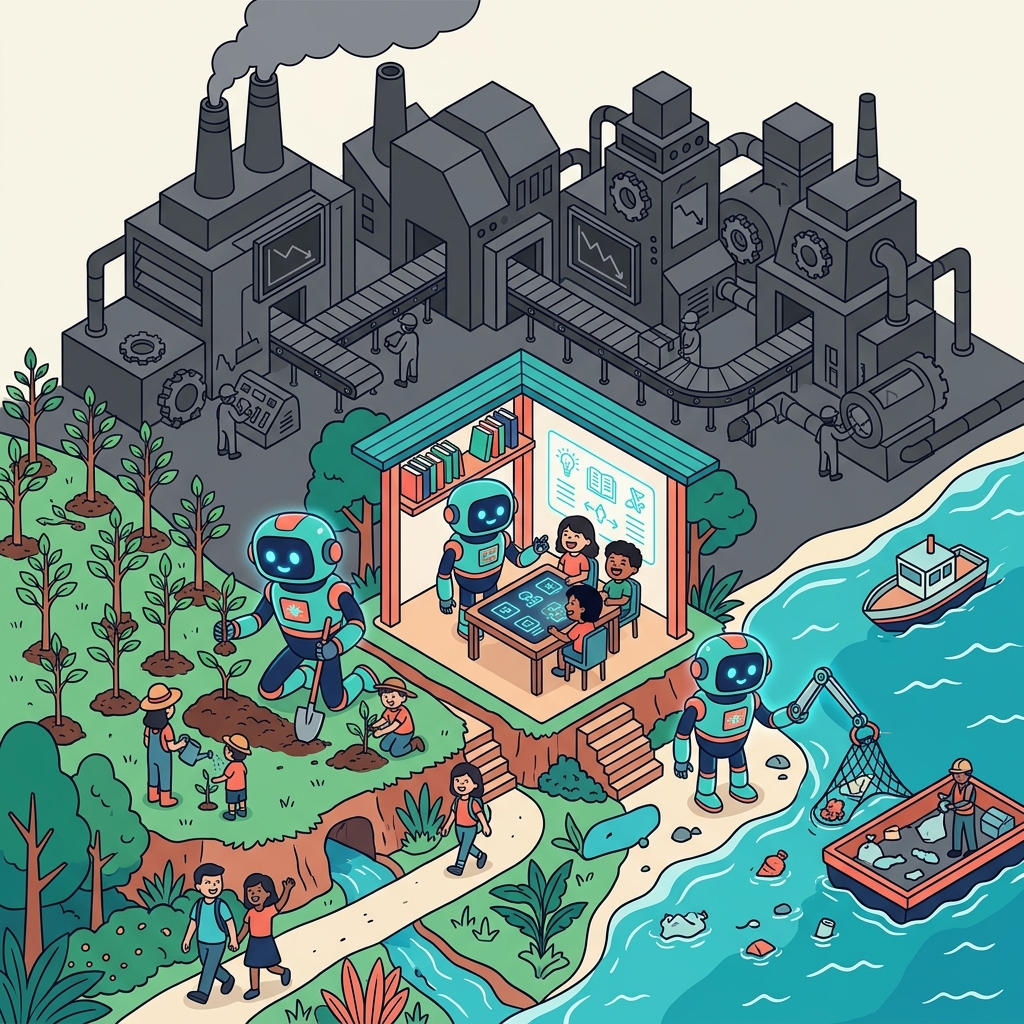
Most AI discourse focuses on business efficiency: faster workflows, lower costs, higher margins. These are real benefits. But they represent a narrow view of what AI can accomplish.
The same technology that optimises ad targeting can optimise resource distribution. The same models that generate marketing copy can generate accessible educational content. The same agents that automate invoicing can automate civic participation.
The question is not what AI can do. It's what we choose to point it at.
The Current Bias
AI development is overwhelmingly funded by and optimised for corporate profit. This creates a systematic bias toward applications that generate revenue: advertising, sales, productivity software, financial trading.
Applications that don't generate direct profit—education, public health, environmental monitoring, civic engagement—receive comparatively little attention from AI developers. Not because AI can't help with these problems, but because solving them doesn't produce quarterly earnings.
What Independent Builders Can Do
This is where small, independent AI practitioners have a unique advantage. You don't answer to shareholders. You don't need to justify your projects to a board. You can point your AI capabilities at problems that matter to you, even if they don't generate revenue.
Accessible Education
Use AI to create educational content that's accessible, free, and available in multiple languages. An AI-assisted course on financial literacy, digital skills, or critical thinking can reach people who would never afford a traditional education.
Community Tools
Build local community tools—meeting organisers, resource directories, neighbourhood communication platforms—using vibe coding. These tools don't need to scale to millions of users. They need to serve hundreds of people well.
Environmental Awareness
Use AI to analyse and visualise environmental data for local communities. Make climate and pollution data accessible and understandable for non-technical audiences.
Open Knowledge
Contribute to open-source AI projects, create open educational resources, and share your workflows and tools freely. Knowledge that's locked behind paywalls benefits only those who can afford it.
The Philosophy
"Human on the Balcony" means having the perspective to see what matters beyond immediate business objectives. From the balcony, you can see that the most impactful uses of AI are often the least profitable—and that independent builders are uniquely positioned to pursue them.
This is not a call to abandon commercial work. It's a call to allocate some of your AI-augmented capability toward problems that matter beyond your own revenue. Even 10% of your time directed toward meaningful impact creates value that no corporate quarterly report can measure.