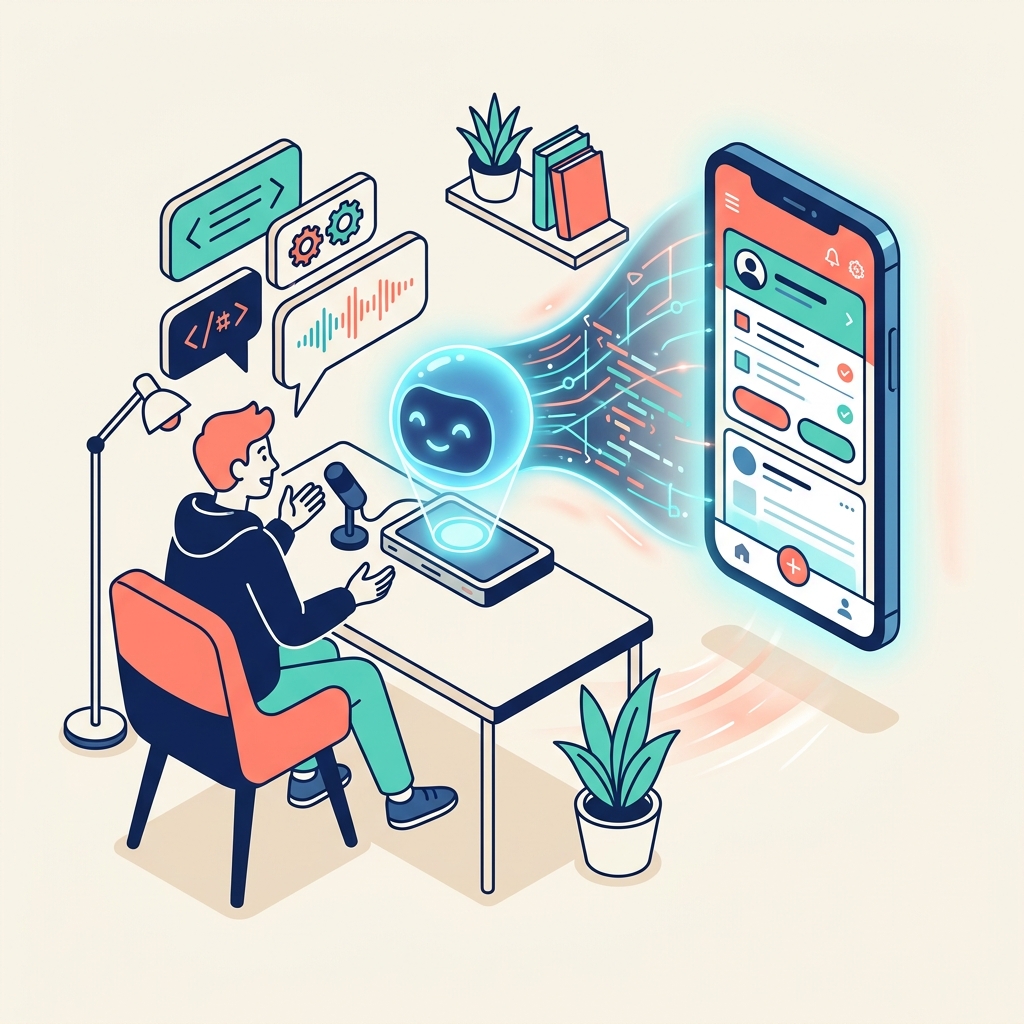
The term "vibe coding" was coined in 2025 to describe a radically different approach to software development: instead of learning programming languages, you describe what you want in plain English and an AI generates the working code. By 2026, it has gone from a niche experiment to a mainstream practice that is fundamentally reshaping who gets to build software.
This is not the same thing as the "no-code" platforms of 2020. Those tools (Bubble, Webflow, Zapier) gave you drag-and-drop interfaces, but they still required you to think in their proprietary logic, and the moment you needed something custom, you hit a wall. Vibe coding generates real, exportable code—React, TypeScript, Python—that you actually own and can deploy anywhere.
How It Works in Practice
The workflow is closer to directing a film than writing a script:
- You define the vision. "Build a client intake form that collects name, email, project type, and budget range. When submitted, it should send the data to my Notion database via the Notion API and trigger a confirmation email."
- The AI generates the code. Tools like Codex, Replit Agent, or Cursor's Composer produce the full application—frontend, backend logic, API integrations—based on your description.
- You review and iterate. You look at the result, test it, and refine: "Make the form responsive. Add a loading spinner. Change the colour scheme to match my brand."
- You deploy. The output is real code. You push it to Vercel, Netlify, or your own server.
Why Creative Professionals Should Pay Attention
The barrier to building software is no longer "can you code?" It's "can you clearly describe what you want?" That is a communication skill, not a technical one. And creative professionals—consultants, content strategists, social media managers—are often better at articulating user needs than engineers, because they spend their careers thinking about audiences and experiences.
Industry data backs this up: a significant majority of US developers now use AI coding tools daily, and a large percentage of new production code is AI-generated. The people who thrive in this environment aren't necessarily the best coders; they're the best communicators and directors.
The Honest Limitations
Vibe coding is extraordinary for:
- Prototypes and MVPs
- Internal tools and dashboards
- Client portals and lead magnets
- Automating repetitive workflows
It is not yet reliable for:
- Mission-critical financial systems
- High-security applications
- Complex enterprise-scale architectures
The quality of your output depends entirely on the quality of your input. Vague prompts produce vague results. Specific, well-structured requirements produce functional applications.
This is the "Human on the Balcony" method applied to software development. You are not writing code; you are directing the creation of code. And that distinction changes everything about what a solo professional can build.