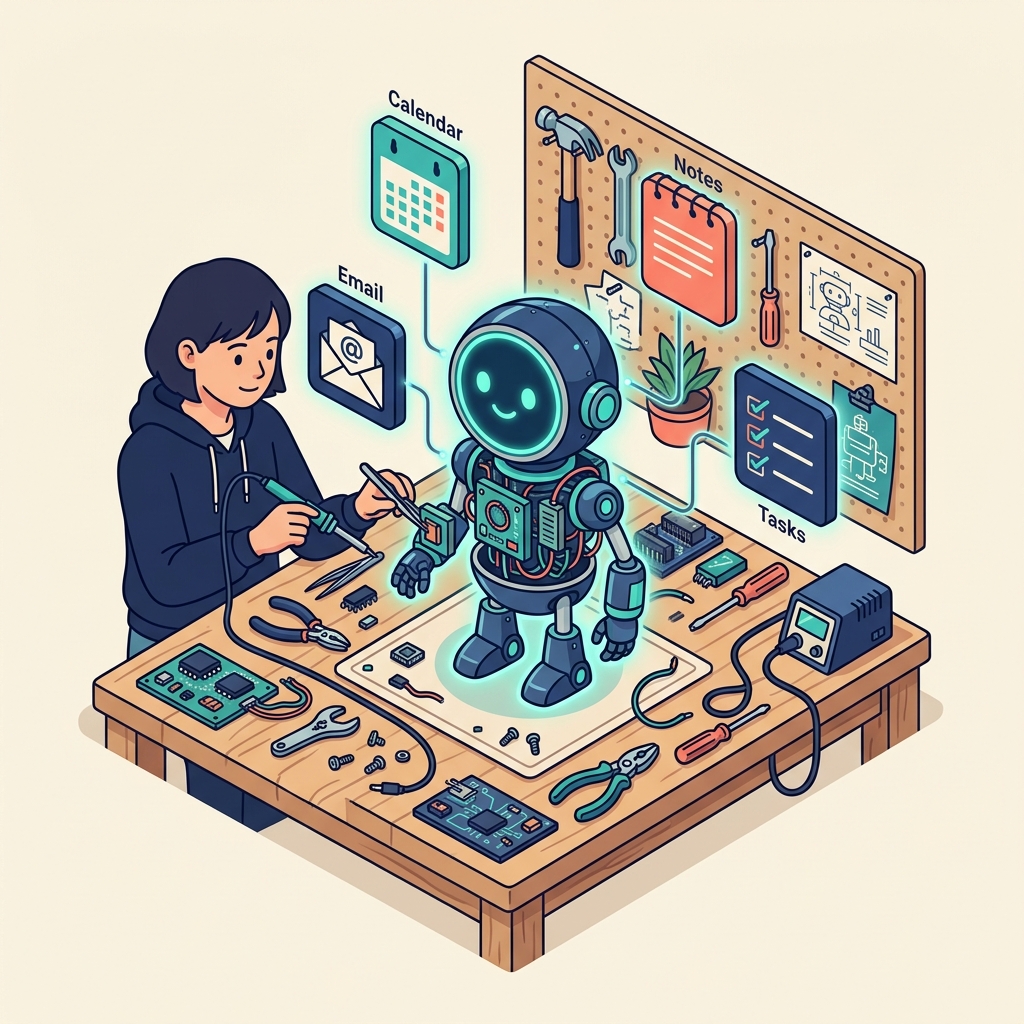
Whenever I talk to other creatives or consultants about the AI space, the first question is always: "What app should I buy to manage my workflow?"
It’s the wrong question. In 2026, the answer isn't a subscription you buy. It’s an assistant you build.
For the last year, my entire workflow has been anchored by Hermes, a local, personalized AI assistant. Building a personal agent through vibe coding shouldn't be your end goal—it should be the very first thing you do. Here is why everything else stems from having your own AI.
The Problem with "Productivity Apps"
We have spent the last decade adapting our brains to fit the software we use. You mold your project management to fit Trello’s boards, or Notion’s databases, or Asana’s timelines.
When you use generic AI tools—like the web interface for ChatGPT or a standard Claude account—you are still playing by their rules. You are battling rate limits, context windows that clear out when you close the tab, and models that forget who you are every time you start a new conversation.
A personal agent flips this dynamic.
What a True Personal Assistant Actually Does
When I talk about Hermes, I am not talking about a customized prompt in a web browser. I am talking about an agent running locally (or via Telegram/Termux on my phone) that has persistent access to my actual life.
- It knows the context before I type: Because my personal agent has access to my Obsidian vault, it knows the exact status of my Become Inspired charity projects, my freelance design pipeline, and my blog calendar. I never have to spend five minutes "priming" it with background information.
- It acts as the architectural sketchpad: As I mentioned in my vibe coding stack breakdown, my personal assistant is where every project starts. I brainstorm the data structures and UI flow with an entity that already understands how I like to code.
- It owns the API integrations: My agent can draft an email, push a calendar event, or pull analytics because I wired it up to do so. It is the central nervous system of my remote workflow.
Why Everything Else Stems From Here
Once you have a functional personal assistant, it becomes the routing layer for your entire digital life.
Need to do heavy-lifting market research? Your personal assistant orchestrates the queries and formats the data exactly how you like to read it. Need to scaffold a new web application? You sketch it with your assistant, and then hand that highly specific brief off to a heavy-lifting tool like Antigravity.
It becomes the ultimate triage system. Instead of checking six different dashboards to figure out what you need to do today, you have a single conversational interface that has already reviewed your pipeline.
It Is Easier Than You Think
The biggest misconception is that building a bespoke agent like Hermes requires a PhD in machine learning.
It doesn't. With the rise of agentic frameworks, building a local assistant that can read your local files and execute basic python scripts is entirely achievable for anyone willing to spend a weekend vibe coding.
Start small. Build an agent that just knows how to read your daily notes. Then, give it the ability to search the web. Then, give it access to your calendar.
Before you know it, you will stop looking for the next great productivity app, because you will have built the only one you actually need.